
Photo Story | “Umm Hasah” — A Millions-of-Years-Old Rock Draped in National Day Light
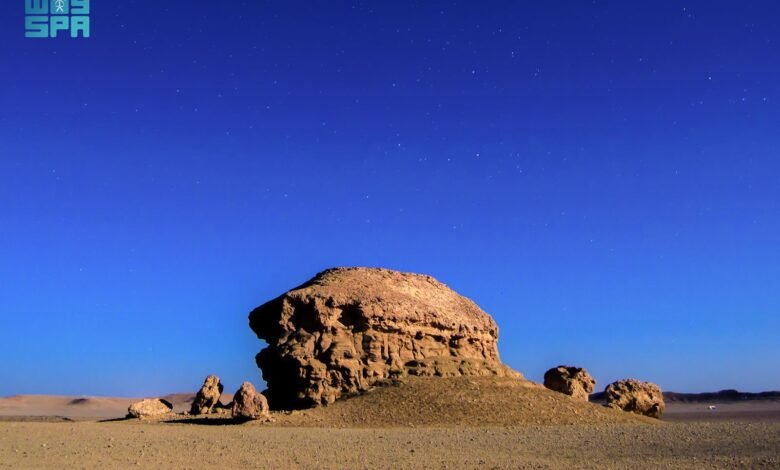
In the heart of the desert in the Northern Borders Region, along the Arar–Al-Jouf road, stands a rock formation known by local residents as “Umm Hasah” or “Al-Hanzaliyah Rock”. In the days leading up to Saudi National Day 96, the natural landmark emerged from its nighttime isolation to become a luminous tableau after its face was covered with light projections bearing the national occasion’s logo and images of the leadership.
The scene brings together two widely separated eras: a rock shaped by weathering and erosion over millions of years, and modern lighting technologies that reintroduced it visually during a contemporary national occasion. That is why we chose it for today’s photo story; the image does not merely document a celebration, but connects the geography of the place with its memory and present.
Where is “Umm Hasah” located?
The rock stands at kilometer 55 on the Arar–Al-Jouf road, on the western shoulder of Wadi Arar in the Northern Borders Region. According to information published by the Saudi Press Agency, SPA, about the landmark, the rock formation ranges from six to seven meters in height and is considered one of the region’s most prominent geomorphological formations.
Its sedimentary layers are clearly visible in photographs. Over long periods of time, these layers were exposed to erosion and weathering until the rock took on the shape known today. In an earlier report by SPA, Nasser Al-Majlad, head of the Aman Environmental Association, highlighted the importance of preserving the site and refraining from tampering with the rock formation, given its natural fragility and the possibility that parts of it could collapse.




When the rock became a national tableau
On September 21, 2026, Saudi media outlets published, citing SPA, photographs of the landmark after it was decorated with light projections in celebration of Saudi National Day. The lighting displayed the occasion’s logo and images of the leadership on the rock’s face, making “Umm Hasah” appear at night like a natural screen amid the expanse of the desert.
Because the recent photographs of the lighting are subject to the copyright of the source that captured them, Barek Media News used an original archival photograph of the same landmark, officially published by the Saudi Press Agency, as its featured image. It does not claim to document the light-projection moment in September 2026; rather, it shows the rock itself and gives readers a clear view of its natural formation and desert setting.
The story of the place extends beyond the occasion
The value of “Umm Hasah” neither begins with National Day nor ends when the lighting is switched off. It is part of the Northern Borders’ geological landscape and a visual testament to the ability of slow natural forces to shape sedimentary rocks over immense spans of time. The national celebration has once again drawn attention to a landmark that travelers on the road might pass without knowing its story.
That is where the power of the image lies: temporary light draws attention to an exceptionally ancient natural feature. Once the projections go dark, the rock remains in place, bearing witness to the region’s geography and memory, while the responsibility to preserve it remains part of the value of the story itself.