The Story Behind a Photograph | 12 Seconds That Changed the World: The Moment the Wright Brothers’ Plane Lifted Off the Ground
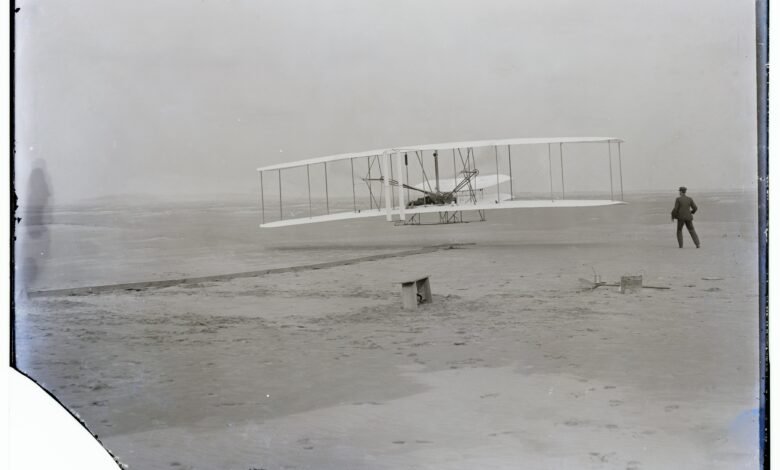
On a cold, windy morning on December 17, 1903, on the sands of Kitty Hawk, North Carolina, a photograph was taken that appears simple at first glance: a fabric-covered wooden machine barely rising above the ground, one man stretched out over its lower wing, and another running alongside it. Yet the image captured one of the moments that changed human movement and the world forever: the first successful flight of a powered, controllable aircraft heavier than air.
Who Is in the Photograph?
Orville Wright was at the controls of the Wright Flyer, while his brother Wilbur Wright appears to the right of the aircraft, running alongside the wing after releasing the support he had been using to steady the machine. According to the U.S. Library of Congress, takeoff occurred at 10:35 a.m. on December 17, 1903.
The first flight lasted just 12 seconds and covered about 120 feet, or roughly 36.6 meters. By modern aviation standards, the distance seems slight, but its significance did not lie in its length; it lay in proving that a powered machine heavier than air could take off and fly in a controlled manner.
The Photographer Who Wasn’t a Photographer
Behind the photograph is a story nearly as unusual as the flight itself. Before the attempt, Orville placed the camera on a tripod and aimed it at the point where he expected the aircraft to arrive at the end of the launch rail. He then showed John T. Daniels, one of the men from the life-saving station at Kill Devil Hills, how to squeeze the rubber bulb that operated the shutter.

The U.S. National Park Service explains that Daniels had never used a camera before. When the aircraft rose, he pressed the shutter at the right moment. The brothers did not immediately know whether the photograph had turned out; the plate was developed later, after they returned to Dayton, Ohio. The result became one of the most famous images in the history of aviation.
What Happened Before This Second?
The flight was not the result of a one-off attempt. Orville and Wilbur spent years studying flight control, building gliders, and testing wings and mechanical systems. On December 14, three days before the photograph was taken, Wilbur attempted to take off with the aircraft, but the effort ended in a hard landing that caused minor damage requiring several days to repair.
On December 17, they tried again amid strong winds. The story did not end with the photographed flight; the brothers made four flights that day, with performance gradually improving. According to the Smithsonian, the fourth and final flight covered 852 feet in 59 seconds.
What Happened After the Photograph?
After the flights, the aircraft was damaged by strong winds and did not fly again that day. But the principle the brothers had pursued had been proven. In the years that followed, they continued developing their aircraft, and within a few decades aviation had become part of transportation, warfare, commerce and the mail system, followed by mass travel around the world.
The irony is that the photograph contains no celebration or enormous crowd. There is no platform, no press cameras and no throng aware that it is witnessing the beginning of a new era. We see only a machine rising a few feet above the sand and two men focused on an engineering experiment.
Why Does the Photograph Remain Important?
The photograph’s power lies in the fact that it documents the moment itself, not a reenactment. The Library of Congress notes that the original 5×7-inch glass negative was among materials deposited by the Wright brothers at the library in 1949. Its digital copy bears the number LC-DIG-ppprs-00626.
Its details also tell the story of the experiment: the launch rail behind the aircraft, Orville’s position on the lower wing, Wilbur watching, and the open sand that was transformed in an instant into the stage for the beginning of modern aviation.
More than a century later, 12 seconds seems extraordinarily brief. But it was enough to separate a world in which controlled flight was an engineering dream from one in which crossing continents in a matter of hours became routine. That is why Daniels’ image remains more than a photograph of an aircraft; it is a visual record of the moment when humans began learning how to leave the ground by their own will and return to it.
Sources
- Library of Congress — Wilbur and Orville Wright Papers: First Flight, and photograph LC-DIG-ppprs-00626.
- U.S. National Park Service — The First Flight and 12 Seconds that Changed the World.
- Smithsonian National Air and Space Museum — The Wright Brothers’ Flight.
Photograph details: The Wright brothers’ first flight, Kitty Hawk, North Carolina, December 17, 1903. Orville Wright piloting the aircraft and Wilbur Wright running alongside it. The photograph was taken by John T. Daniels using a camera prepared by Orville Wright. Source: Library of Congress, LC-DIG-ppprs-00626. The historic photograph is in the public domain/no known restrictions on publication.