
Image Story | Saturn Takes Center Stage Tonight: Why Its Rings Are at Their Best for Observation
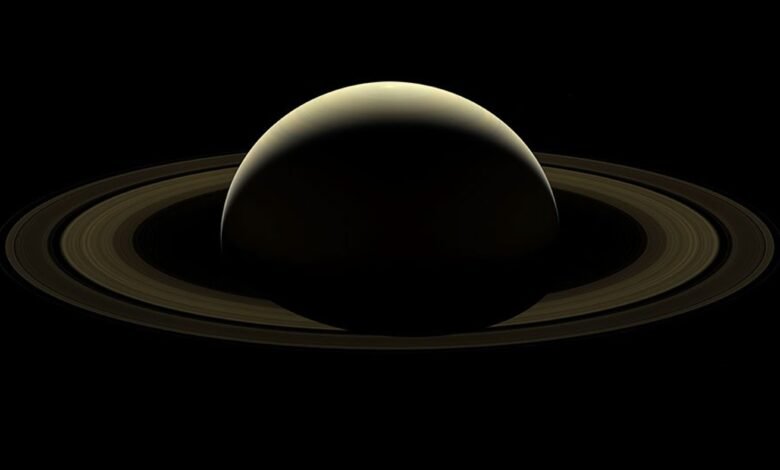
In an image that looks like a painting hanging in the darkness of space, Saturn floats surrounded by its broad rings, while shadow covers a large portion of the planet’s disk. This real image was captured by the Cassini spacecraft and is back in the spotlight today because October 4, 2026, marks one of the most important opportunities to observe Saturn this year: the planet’s opposition.
According to NASA’s monthly skywatching guide, Saturn reaches opposition today—the moment when Earth passes approximately between the Sun and Saturn. As a result, the planet lies opposite the Sun in the sky, rising around sunset and remaining visible for most of the night.
What does the image tell us?
The image chosen by Break for this story is neither a drawing nor an AI-generated picture. It is a natural-color mosaic made from dozens of images captured by Cassini’s wide-angle camera on September 13, 2017, just two days before the spacecraft’s historic plunge into Saturn’s atmosphere.
NASA explains that the final scene was assembled from 42 images using red, green and blue filters. Cassini was about 1.1 million kilometers from Saturn when it recorded the images. Upon close inspection of the original high-resolution version, several of Saturn’s small moons can be seen around the ring system.




Why is opposition the best time to observe Saturn?
Opposition places Saturn in an excellent observing position: the planet is opposite the Sun, allowing many hours to view it from evening until just before dawn. NASA says October 4 gives skywatchers one of the year’s best opportunities to observe the ringed planet.
To the naked eye, Saturn appears as a relatively steady point of light, while its famous rings require binoculars or a small telescope to see clearly. The farther observers are from city lights and the clearer the sky, the better the view will be.
Cassini: The final image before farewell
The image carries additional significance because it was taken during Cassini’s final days. The spacecraft orbited Saturn for more than 13 years before ending its mission on September 15, 2017, by deliberately plunging into the planet’s atmosphere after a journey that produced an enormous volume of data about Saturn, its rings and its moons.
NASA says the complete farewell scene included six faintly visible moons: Enceladus, Epimetheus, Janus, Mimas, Pandora and Prometheus. The image therefore represents more than a beautiful view; it is a scientific record of the final moments of one of the most important missions to explore the solar system.
October’s sky does not stop at Saturn
NASA’s October skywatching calendar includes other events, including the Moon’s close approach to Jupiter before sunrise on October 6, the peak of the Orionid meteor shower on October 21 and 22, and the Moon’s passage near the Pleiades star cluster on October 27 and 28.
For more space-image stories on Break, read Curiosity’s Mars selfie story.
Sources
NASA Science — What’s Up: October 2026 Skywatching Tips.
NASA/JPL-Caltech/Space Science Institute — A Farewell to Saturn (PIA17218).