
Riyadh concludes UNESCO Forum on the Ethics of Artificial Intelligence as 217 trainees from 41 countries graduate from applied program
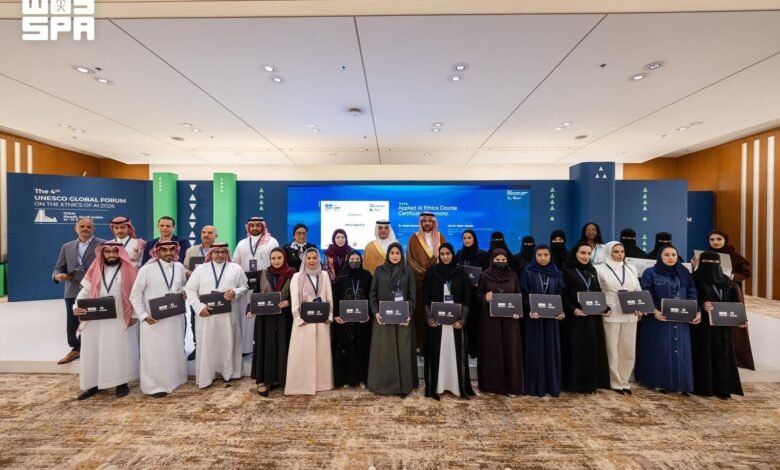
Riyadh concluded the fourth edition of UNESCO’s Global Forum on the Ethics of Artificial Intelligence on Thursday, September 17, 2026, marking an international milestone focused on translating the principles of responsible governance into practical tools and skills. On the final day, the International Center for AI Research and Ethics (ICAIRE) celebrated the graduation of 217 trainees from 41 countries and regions as part of the first cohort of the “Applied Ethical Artificial Intelligence” program.
The achievement came as part of the forum, which Saudi Arabia hosted for the first time in the Arab world. It was organized by the Saudi Data and Artificial Intelligence Authority (SDAIA) in partnership with the United Nations Educational, Scientific and Cultural Organization (UNESCO), and in cooperation with ICAIRE, from September 14 to 17 in Riyadh.
217 trainees and skills extending beyond the technical dimension
According to the Saudi Press Agency, the training program was conducted from July 14 to 29, 2026, and included six live sessions organized around three main areas: understanding artificial intelligence, using its tools to enhance productivity without requiring a programming background, and applying ethical principles when working with these technologies.
The training content covered the fundamentals of modern systems, the role of models, data, algorithms and large language models, as well as prompt-engineering skills and the development of repeatable workflows. The diversity of participants from 41 countries and regions reflects the growing international interest in building practical capabilities that take responsibility into account alongside technical proficiency.




Riyadh at the heart of the global AI governance debate
The fourth Global Forum was themed around shifting international cooperation toward ethical governance of artificial intelligence. UNESCO says the forum brings together experts and leaders from around the world to support implementation of its Recommendation on the Ethics of Artificial Intelligence, an international framework focused on human rights, sustainability, responsible innovation and inclusion.
During the Riyadh edition, UNESCO also introduced new tools to help policymakers assess countries’ readiness and strengthen governance. Among the أبرز tools were the updated version of the Readiness Assessment Methodology, “RAM 2.0,” an analysis of global trends in AI governance, and a tool addressing the environmental impact of intelligent systems and ways to mitigate it.
From principles to practice
The significance of graduating the new cohort does not stop at the number of participants. The shift from discussing AI ethics to training users and specialists in practical approaches represents one of the core challenges facing governments and institutions. As the use of generative models and automated systems expands, issues of transparency, privacy, fairness and accountability are becoming part of everyday use decisions rather than a theoretical subject separate from the technology.
Riyadh’s hosting of the forum, coinciding with the Year of Artificial Intelligence in Saudi Arabia, also strengthens the Kingdom’s presence in the international debate over how to develop and use advanced technologies responsibly, while giving local institutions greater opportunities to cooperate with international bodies in building policies and human capabilities.
Sources
UNESCO – Global Forum on the Ethics of Artificial Intelligence