
The Story Behind a Photograph | “Migrant Mother” — A Face from 1936 That Condensed the Hardship of the Great Depression
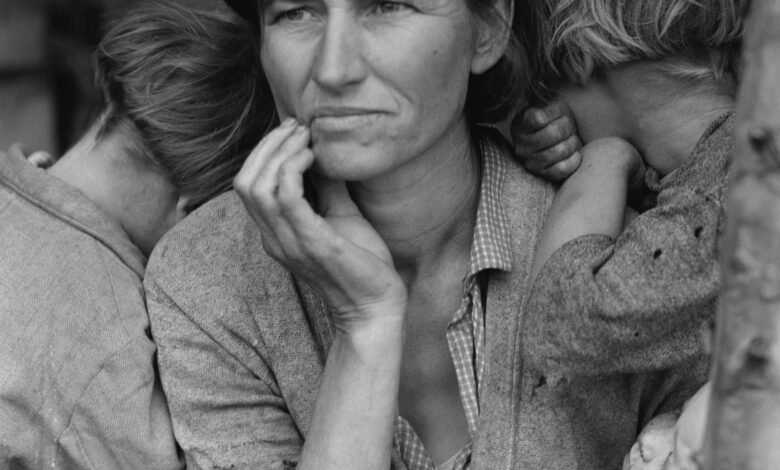
A 32-year-old woman gazes into a distance we cannot see, two children bury their faces against her shoulders, and an infant rests in her lap. There is no sign in the frame explaining the crisis, no lines of unemployed workers or collapsed stock markets. Yet the image became one of the photographs most closely associated with the Great Depression in the American memory.
The photograph later known as “Migrant Mother” was taken by photographer Dorothea Lange in March 1936 near Nipomo, California. Library of Congress records identify the woman as Florence Owens Thompson and document the photograph as part of the Farm Security Administration/Office of War Information collection.
The Nipomo Pea Pickers’ Camp
Lange was at the end of a journey lasting roughly a month to document the conditions of migrant agricultural workers in California on behalf of the U.S. Resettlement Administration. In Nipomo, she arrived at a camp for pea pickers at a time when an early crop failure had left large numbers of workers without sufficient income or food.
According to the archival information accompanying the series of photographs, the family consisted of seven children, and the mother was 32 years old. One photograph caption states that the family was living in extremely harsh conditions and that many of those in the camp were destitute.




It Was Not a Single Shot
What we know today as “Migrant Mother” was not created with a single press of the shutter. The Library of Congress documents a series of photographs Lange took of the family, gradually moving closer to the mother and her children. In the best-known image, the distance had narrowed until Florence’s face became the center of the scene, while two children turned their faces away from the camera.
This simple composition made the gaze, the hand and the lines on the face carry most of the story. The woman’s identity had not been recorded by name when the photograph was taken; the original archival title described her as a 32-year-old mother of seven, while she was later identified as Florence Owens Thompson.
What Do We Know for Certain—and What Requires Caution?
Library of Congress records establish that the photograph was taken in Nipomo in March 1936, that the photographer was Dorothea Lange, and that it was part of a government documentation project on the lives of workers and migrants during the Depression years. The library also notes that the photograph became one of its most requested images.
However, some details Lange recounted decades later about the circumstances of the encounter differ from later accounts by the family. It is therefore not appropriate to treat every detail circulated about the moments preceding the photograph as established fact. The archive itself points to the absence of some expanded textual records related to the series, making it essential to distinguish between the documentation and later narrative.
From an Unknown Woman to a Symbol of an Entire Era
The photograph spread and, over the years, became a visual symbol of poverty and uncertainty during the Great Depression. Photography official Roy Stryker later described it as the outstanding photograph of that era, while Florence’s features and those of her children became a recurring reference in books, exhibitions and studies of documentary photography.
The photograph’s importance does not come from its ability to summarize Florence’s entire life; it cannot do that. Its power lies in preserving a specific moment from a larger crisis and reminding us that the economic statistics written in the millions were ultimately experienced inside a tent and on the faces of real families.
The Photograph and Usage Rights
Photograph: Dorothea Lange / Farm Security Administration – Library of Congress, Prints & Photographs Division. Date: March 1936. Location: Nipomo, California, United States. Digital reproduction number: LC-DIG-fsa-8b29516. The Library of Congress explains that there are no known restrictions on publishing the “Migrant Mother” photographs in this collection, and that materials from the government FSA/OWI collection are described as available for use and reuse in the public domain.
Sources
- Library of Congress — The original photograph record, LC-DIG-fsa-8b29516.
- Library of Congress — Guide to Dorothea Lange’s “Migrant Mother” photographs and the series of images.
- Library of Congress — FSA/OWI Black-and-White Negatives: Rights and Restrictions.