
Is It Permissible to Delay Prayer Because of Work or Study? Sheikh Ibn Baz’s Documented Answer

An employee or student may face a busy day in which meetings or lectures overlap with prayer times, prompting an important question: Is it permissible to delay prayer because of work or study? This article does not offer an independent fatwa from “Break Media News”; rather, it summarizes an answer published on the official website of Sheikh Abdulaziz bin Baz, may Allah have mercy on him, while distinguishing between delaying prayer beyond the beginning of its time while still performing it within that time, and allowing it to go beyond its prescribed time.
What is the basic rule regarding prayer times?
Sheikh Abdulaziz bin Baz explained that the obligation is to perform prayer within its prescribed time, citing the words of God Almighty: “Indeed, prayer has been decreed upon the believers at specified times” [An-Nisa: 103]. In the context of his answer, this means that prayers are obligatory at specific times, and that routine work or study may not be used as a reason to let a prayer pass beyond its prescribed time.
It is important here to note a key distinction: not every delay beyond the beginning of the prayer time means delaying the prayer beyond its prescribed time. In another official answer concerning university lectures, the sheikh explained that performing prayer at the beginning of its time is preferable, but delaying it for a while due to an excuse or a legitimate interest, while still performing it within its prescribed time, is unobjectionable. Thus, a student or employee may arrange a suitable break for prayer as long as it is performed before the prayer time ends.
What about lectures or working hours?
In a question published on the sheikh’s official website about a student who has difficulty performing the afternoon prayer because of his studies, the sheikh affirmed that studying is not, in itself, a justification for allowing the prayer time to pass, and that each prayer must be performed within its prescribed time. He also called on officials, managers and teachers to cooperate in facilitating the performance of prayer.
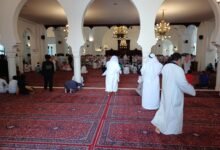
In practical terms, this answer indicates that Muslims should organize their day to find a suitable opportunity within the prescribed time: before a long meeting if the prayer time has begun, during a break, or after a lecture ends if time for the prayer remains. The point is to observe the limits of the prescribed time, not to require prayer at the very first minute after its time begins.
Are there cases of necessity?
In a separate answer, Sheikh Ibn Baz stated that genuine necessities may be subject to different rulings, giving as examples rescuing a drowning person, dealing with a fire, or responding to a danger that could not be addressed if the person were to leave it unattended. These are exceptional cases and should not be compared with routine daily work. The sick and travelers also have religious rulings permitting the combination of certain prayers under specific conditions; these are matters with detailed jurisprudential rulings.
Therefore, concessions and exceptions should not be turned into a general rule, nor should one be excessively strict by regarding every delay within the prescribed time as negligence; the official sources themselves distinguish between the two matters.
If the prayer is missed because of sleep or forgetfulness
In another answer, the sheikh explained that anyone who misses a prayer because of sleep or forgetfulness should perform it as soon as he wakes up or remembers, and should not deliberately postpone it to another time. This differs from deliberately allowing the prayer time to pass because of ordinary preoccupation.
Conclusion
According to the fatwas of Sheikh Abdulaziz bin Baz published officially, routine work or study does not justify deliberately allowing the prayer time to pass. Delaying prayer beyond the beginning of its time while still performing it within that time may be permissible, although performing it at the beginning of its time is preferable in principle. In cases of genuine necessity, there are rulings and exceptions whose details should be referred to qualified scholars.
Note: This article is an editorial summary of officially published fatwas and is not a fatwa issued by Break Media News or by artificial intelligence. Anyone with a specific situation involving illness, travel, necessity or unusual circumstances should preferably consult a trusted scholarly authority about their particular case.
Sources
- Official website of Sheikh Abdulaziz bin Baz: Ruling on advancing or delaying prayer beyond its prescribed time because of study.
- Official website of Sheikh Abdulaziz bin Baz: Ruling on delaying prayer beyond the beginning of its time because of university lectures.
- Official website of Sheikh Abdulaziz bin Baz: Ruling on delaying prayer beyond its prescribed time due to necessity.
- Official website of Sheikh Abdulaziz bin Baz: What is the ruling on someone who delayed prayer beyond its prescribed time for an excuse?.